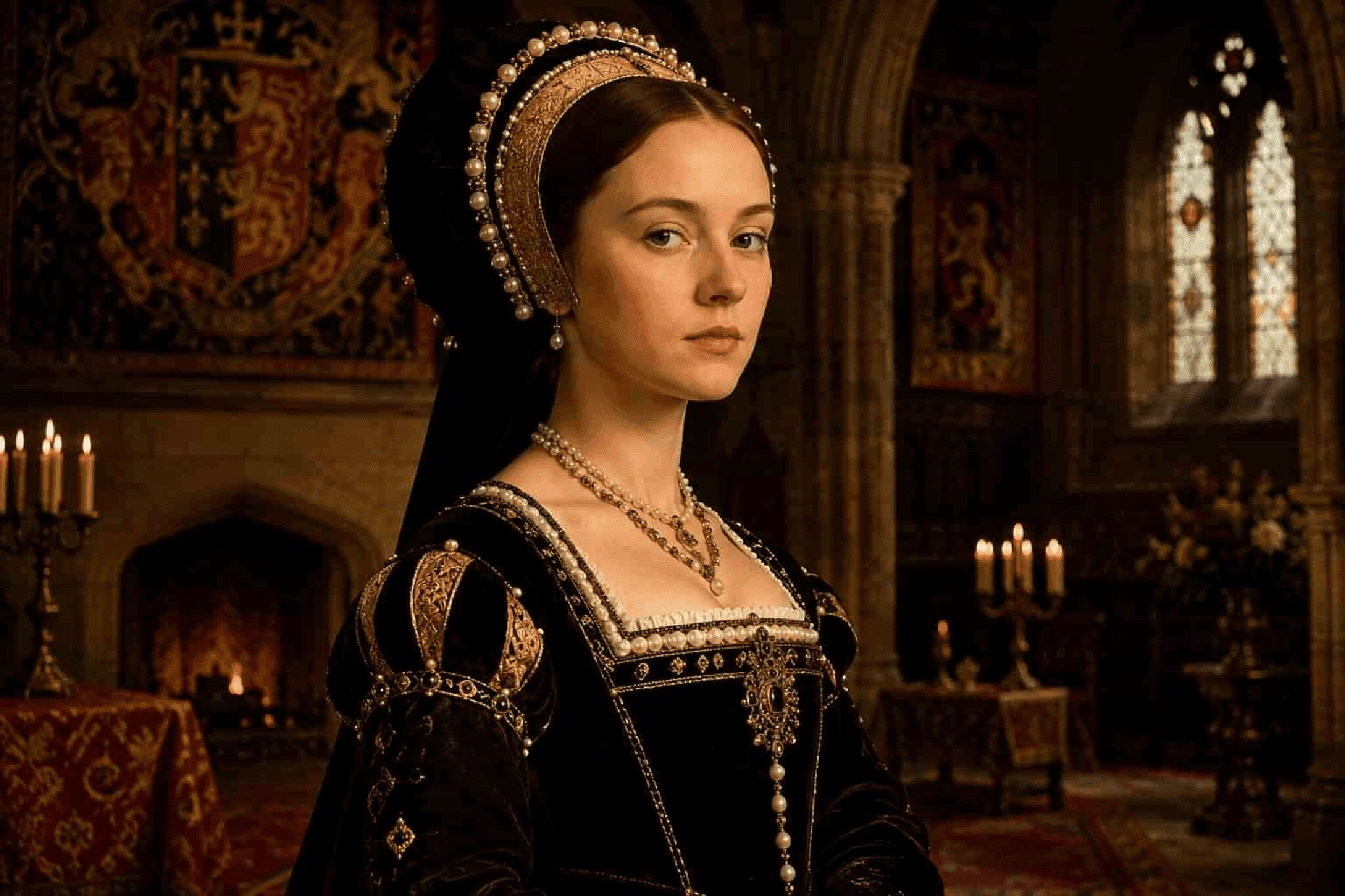
Who Was Anne Boleyn? Her Life, Love and Tragic Downfall
Most people know Anne Boleyn as “the wife Henry VIII beheaded.” That single line hides one of the boldest, most intelligent women in English history. She helped split a country from Rome, gave England its most famous queen, and paid for it with her life. This guide tells her full story, from Hever Castle to the Tower of London.
Quick Facts About Anne Boleyn
Before the full story, here is a snapshot table you can scan in seconds.
| Fact | Detail |
|---|---|
| Full name | Anne Boleyn |
| Born | c. 1501 (some historians argue 1507), Blickling Hall or Hever Castle |
| Died | 19 May 1536, Tower of London |
| Father | Sir Thomas Boleyn, Earl of Wiltshire |
| Mother | Lady Elizabeth Howard |
| Spouse | King Henry VIII (married 1533) |
| Reign as Queen | 1533–1536 (around 1,000 days) |
| Daughter | Princess Elizabeth, later Elizabeth I |
| Cause of death | Execution by beheading, charged with treason and adultery |
| Buried at | Chapel Royal of St Peter ad Vincula, Tower of London |
Her short reign changed the religious and political shape of England forever. This story deserves more than a single dramatic headline.
Early Life and Family Background
Anne was born into a well-connected but not royal family. Her father, Sir Thomas Boleyn, was a respected diplomat and courtier. Her mother, Elizabeth Howard, came from the powerful Howard family, one of the highest-ranking noble houses in England.
Historians still argue over her exact birth year. Eric Ives, a leading Tudor historian, places her birth around 1501. Retha Warnicke, another respected biographer, argues for 1507 instead. Either way, she spent much of her early childhood at Hever Castle in Kent, a home that still stands today and welcomes visitors.
Her family’s connections opened doors most young women of the era never saw. Thomas Boleyn used his position at court to secure his daughter a rare and valuable education abroad.
Education in France and the Netherlands
In 1513, Thomas Boleyn sent his daughter to serve at the court of Margaret of Austria in the Netherlands. This was a significant honor, reserved for young women from ambitious, well-placed families.
She then moved to the French court, where she spent nearly seven years. There, she served under Queen Claude of France and absorbed French language, fashion, music, and manners.
This continental polish set her apart from other English women at court. She returned to England around 1521 as a confident, sophisticated woman fluent in French culture, poetry, and courtly behavior. That difference caught attention the moment she arrived.
How Anne Boleyn Met King Henry VIII
Anne joined the household of Queen Catherine of Aragon as a lady-in-waiting after returning to England. Her sister, Mary Boleyn, had already caught the king’s eye and became his mistress for a period.
Her early romantic life took a different turn first. She fell in love with Henry Percy, a young nobleman, and the couple secretly became betrothed. Cardinal Wolsey broke off the match on the king’s orders, and she was sent home to Hever Castle in disgrace.
By the mid-1520s, Henry VIII had noticed her himself. Unlike her sister, she refused to become his mistress. She insisted on marriage or nothing at all, a decision that reshaped English history.
The Courtship: Love Letters and a Six-Year Wait
Henry VIII pursued the woman he wanted to marry for roughly six years before their wedding. He wrote her numerous love letters, several of which survive today in the Vatican Library.
Her refusal to become a royal mistress forced Henry into a difficult position. He was still married to Catherine of Aragon, and the Pope would not grant an annulment. This standoff triggered one of the most consequential political crises in English history.
Question: Why wouldn’t the Pope allow Henry VIII to divorce Catherine of Aragon? Short answer: Catherine’s nephew, Emperor Charles V, controlled Rome militarily at the time, and the Pope could not risk angering him by approving the annulment.
Frustrated by Rome’s refusal, Henry began exploring a radical solution: breaking England away from the Catholic Church entirely.
Her Role in the English Reformation
She was more than a romantic obstacle in Henry’s marriage plans. She actively encouraged religious reform and supported scholars who questioned papal authority.
She introduced Henry to reform-minded texts, including works that argued kings should hold authority over the church in their own countries. Thomas Cranmer, who later became Archbishop of Canterbury, benefited directly from her support.
This pressure contributed to the Act of Supremacy in 1534, which made Henry VIII the head of the Church of England. Her influence on this shift is one reason historians consider her far more than a footnote in Tudor history. She helped reshape English religion for centuries to come.
The Secret Marriage and Coronation
Henry and his bride married secretly on 25 January 1533 at Whitehall Palace. Only a handful of witnesses attended the ceremony, and she was already pregnant with the child who would become Elizabeth I.
On 1 June 1533, Anne Boleyn was crowned Queen of England at Westminster Abbey. She processed through London in a litter of white cloth of gold, wearing fur-trimmed purple robes reserved for royalty.
She holds a unique distinction in English history: she was the last queen consort to be crowned independently with St Edward’s Crown, an honor usually kept for reigning monarchs alone.
Birth of Elizabeth and Mounting Pressure
On 7 September 1533, she gave birth to a healthy daughter, Princess Elizabeth, at Greenwich Palace. Henry had promised the country a son and heir, and the birth of a girl was treated as a disappointment at court.
Planned celebration jousts were quietly cancelled. She suffered further heartbreak afterward, including at least one miscarriage in 1536 that involved a male fetus.
Henry’s patience wore thin as he grew infatuated with Jane Seymour, one of his wife’s own ladies-in-waiting. This shift in the king’s affection set the stage for a sudden and shocking downfall.
The Arrest and Trial of Anne Boleyn
On 2 May 1536, she was arrested at Greenwich Palace and taken by barge to the Tower of London. She was charged with adultery, incest, and plotting the king’s death.
Five men were accused alongside her, including her own brother, George Boleyn. Most historians today agree the charges were fabricated. Thomas Cromwell, once her political ally, is widely believed to have orchestrated the case against her to satisfy the king’s wish to remarry.
The trial lasted only a few days. A jury of noblemen, including her own uncle, found her guilty. The verdict shocked much of the court, though few dared speak against the king.
Her Execution at the Tower of London
She was executed on 19 May 1536 on Tower Green, inside the Tower of London. Henry granted one small mercy: he brought in a skilled swordsman from Calais instead of using the usual axe, sparing her a slower death.
Witnesses described her final speech as calm and dignified. She avoided directly criticizing the king and instead prayed for his wellbeing, a common practice meant to protect surviving family members from royal punishment.
She was buried in an unmarked grave inside the Chapel Royal of St Peter ad Vincula at the Tower of London. Eleven days later, Henry VIII married Jane Seymour.
Timeline of Anne Boleyn’s Life
| Year | Event |
|---|---|
| c. 1501 | She is born, likely at Blickling Hall or Hever Castle |
| 1513 | Sent to the court of Margaret of Austria in the Netherlands |
| 1514–1521 | Serves at the French royal court |
| 1522 | Returns to England, joins Catherine of Aragon’s household |
| 1525 | Henry VIII begins pursuing her romantically |
| 1533 | Secret marriage to Henry VIII; crowned Queen of England |
| 1533 | Birth of Princess Elizabeth |
| 1536 | Miscarries a male child in January |
| 1536 | Arrested on 2 May; executed on 19 May |
This timeline shows just how fast her fortunes rose and fell within a single decade.
Her Legacy and Impact on History
Her greatest legacy walked through history in the form of her daughter. Elizabeth I became one of England’s most successful monarchs, ruling for 44 years during a golden age of exploration and culture.
Elizabeth quietly honored her mother throughout her reign. She used the falcon emblem her mother had chosen for palace decorations and kept a secret ring containing a hidden portrait of her mother until her own death in 1603.
Beyond her daughter’s reign, the push for religious reform permanently altered England’s relationship with the Catholic Church. Her story remains one of the clearest examples of how personal ambition and political power collided during the Tudor period.
Her Story in Books, Film, and Television
Her dramatic story has fascinated writers and filmmakers for centuries. Popular portrayals include:
- The Other Boleyn Girl – a novel and film exploring the rivalry between the two Boleyn sisters
- Wolf Hall – a Booker Prize-winning novel and BBC series told from Thomas Cromwell’s perspective
- The Tudors – a television series dramatizing Henry VIII’s entire reign
- Anne Boleyn (2021) – a psychological drama miniseries focusing on her final months
These adaptations mix fact with fiction, so readers researching her real history should always cross-check dramatic scenes against verified historical records.
Places Linked to Anne Boleyn You Can Visit Today
Several historic sites connected to her remain open to the public across England.
| Location | Connection |
|---|---|
| Hever Castle, Kent | Her childhood home; original Boleyn family apartments survive |
| Tower of London | Site of her imprisonment, execution, and burial |
| Hampton Court Palace | Her initials remain carved alongside Henry’s in the Great Hall |
| Westminster Abbey | Site of her coronation in June 1533 |
| Greenwich Palace grounds | Birthplace of Princess Elizabeth |
Visiting these sites gives a grounded, physical sense of her rise and fall that books alone cannot fully capture.
Common Myths About Her Life
Popular culture has stretched the truth around her life in several ways. Here are corrections worth knowing:
- Myth: She had six fingers on one hand. Fact: No contemporary source confirms this claim; it likely originated from hostile propaganda written after her death.
- Myth: She seduced Henry VIII purely for power. Fact: Surviving letters show Henry pursued her for years while she resisted becoming his mistress.
- Myth: The charges against her were true. Fact: Most modern historians consider the adultery and incest charges politically manufactured.
Separating fact from myth helps readers understand her as a real historical figure rather than a storybook villain.
Frequently Asked Questions About Anne Boleyn
1. When was Anne Boleyn born?
She was likely born around 1501, though some historians argue for 1507 based on surviving letters. No official birth record exists, so historians rely on indirect evidence like her education timeline and handwriting samples from a 1514 letter to her father.
2. Why did Henry VIII execute Anne Boleyn?
Henry VIII executed her after accusing her of adultery, incest, and treason in 1536. Most historians believe the real motive was Henry’s desire to marry Jane Seymour and his frustration over her failure to produce a male heir.
3. How long was she queen of England?
She served as Queen of England for approximately 1,000 days, from her coronation in June 1533 until her execution in May 1536. Despite the short reign, her influence on English religion and politics lasted for generations.
4. Who was Anne Boleyn’s daughter?
Her only surviving child was Princess Elizabeth, born in 1533, who later became Queen Elizabeth I. Elizabeth ruled England for 44 years and became one of the most celebrated monarchs in English history.
5. Where is she buried?
She is buried at the Chapel Royal of St Peter ad Vincula within the Tower of London grounds. Her grave was originally unmarked, and Victorian-era renovations later identified and marked her resting place.
6. Did Anne Boleyn actually commit the crimes she was accused of? Most historians today believe the charges against her were fabricated to justify her removal. Evidence presented at her trial was thin, several accused men had documented alibis, and the timeline of alleged affairs does not match court records.
Final Thoughts on Anne Boleyn’s Story
She lived a short life packed with ambition, love, power, and tragedy. She refused to settle for the role offered to her, and that refusal changed the course of English history.
Her legacy lives on through her daughter, through England’s break from Rome, and through the countless historic sites you can still visit today. Which part of her story surprised you the most? Share your thoughts in the comments, or explore Hever Castle and the Tower of London to walk through her history firsthand.