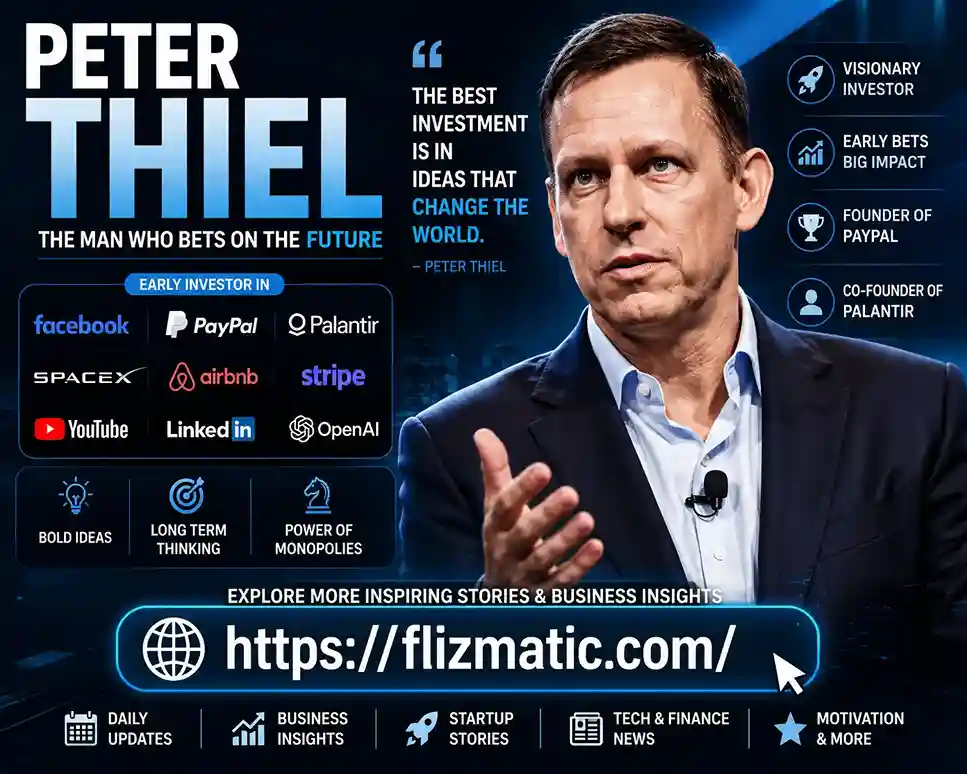
Peter Thiel: The Contrarian Playbook for Building the Future
Most people copy what works. Peter Thiel does the opposite. He looks for secrets—valuable truths that few agree on. This mindset turned a grad school idea into PayPal. It made him the first outside investor in Facebook. And it built Palantir, a data empire.
Peter Thiel does not chase trends. He builds monopolies. This guide breaks down his exact framework. You will learn his zero-to-one philosophy, his famous interview question, and how to apply his thinking to your own work.
Who Is Peter Thiel? The Path from Law to PayPal
Peter Thiel started as a law clerk. He saw the legal path as safe but empty. Within seven months, he quit. He moved to California and co-founded Confinity. That company built a way to send money via PalmPilots. That product became PayPal.
In 2002, Peter Thiel sold PayPal to eBay for $1.5 billion. Most founders would retire. He did not. He funded Palantir Technologies, a data-analytics firm now worth over $20 billion. He also became Facebook’s first major angel investor. His $500,000 check turned into more than $1 billion.
Today, Peter Thiel runs Founders Fund. He backs radical science, AI, and longevity research. His path proves one rule: do not compete. Create something new.
The Zero to One Philosophy Explained Simply
Peter Thiel wrote Zero to One with Blake Masters. The core idea is simple. Going from zero to one means creating a new solution. Going from one to n means copying what works.
| Concept | Zero to One | One to n |
|---|---|---|
| Action | Invention | Replication |
| Outcome | Monopoly | Competition |
| Example | First iPhone | Android clones |
| Profit | High & lasting | Low & fleeting |
| Difficulty | Hard, lonely | Easy, crowded |
Peter Thiel argues that true wealth comes only from zero-to-one moves. Globalization is horizontal progress. Technology is vertical progress. Both matter, but vertical progress changes civilization. Every monopoly you admire started as a secret others ignored.
Why Monopolies Are Good (According to Peter Thiel)
Textbooks call monopolies bad. Peter Thiel disagrees. He says monopolies drive progress. A monopoly makes enough profit to fund long-term R&D. Google can spend billions on AI because no search rival threatens its core cash.
Competitive markets destroy margins. Restaurants fight over 5% profit. Airlines earn less per passenger than a vending machine. Peter Thiel observed that perfect competition means zero profit. A healthy monopoly, like Microsoft in the 1990s, creates new industries.
The key difference is perception. Monopolies hide their power. They pretend to face competition. Google calls itself a tech company, not a search monopoly. Peter Thiel says this is smart. Bragging about monopoly status invites regulation. Stay under the radar.
The Famous “What Important Truth Do Few Agree With?”
Peter Thiel asks every job candidate the same question: “What important truth do very few people agree with you on?” A great answer sounds wrong at first. Then it flips your thinking.
A weak answer says “hard work pays off.” Almost everyone agrees. A strong Peter Thiel answer says “rent control destroys cities.” Or “most universities will collapse by 2035.” The best answer reveals a secret that enables a new business.
- Example: Few believed people would pay to sleep on strangers’ couches. Airbnb saw the truth: travelers want authentic experiences.
- Example: Few believed a $100,000 electric car would sell. Tesla saw the truth: status-seeking early adopters exist.
- Example: Few believed a video website would beat Hollywood. YouTube saw the truth: amateur content is entertaining.
Peter Thiel uses this question to find contrarian founders. If your answer does not scare someone, it is not bold enough.
Secrets: The Hidden Engine of Silicon Valley
Peter Thiel believes secrets still exist. Most people think everything important is already discovered. That is a dangerous lie. The greatest companies are built on secrets—hard truths that are either unknown or disbelieved.
| Type of Secret | Example | Company Built |
|---|---|---|
| Scientific | DNA can be edited cheaply | CRISPR Therapeutics |
| Behavioral | People overshare online | |
| Mathematical | Search results can be ranked by links | |
| Economic | Small loans to the poor work | M-Pesa |
| Psychological | Gamification drives work output | Many SaaS tools |
Peter Thiel advises founders to ask: “What is the secret that only my team understands?” If you cannot answer in one sentence, you do not have a real business. Secrecy also protects you. Do not tell everyone your insight. Tell only co-founders and early employees.
How Peter Thiel Picks Founders to Fund
Peter Thiel does not invest in slideshows. He invests in people with intense vision. He looks for founders who see a specific future and will not stop until it arrives. These founders are often awkward, intense, and slightly obsessive.
Founders Fund, co-founded by Peter Thiel, lists its criteria clearly:
- Defiant Optimism: The founder believes the impossible is just delayed.
- Technical Insight: They understand something hard that most do not.
- Team Obsession: They recruit only the top 1% of talent.
- Product Zealotry: They live and breathe their own product daily.
- Long-Term Horizon: They think in decades, not quarters.
Peter Thiel famously passed on Twitter because he saw it as a feature, not a company. He was wrong. But he prefers missing a good deal to funding a bad one. His best investments—Facebook, Stripe, SpaceX—all had founders who refused to give up.
Palantir and Data: The Power of Secret Keeping
Palantir is Peter Thiel’s most misunderstood company. It builds software that connects data silos. Governments use it to find terrorists. Banks use it to catch fraud. Palantir’s power is not just technology. It is secrecy.
Palantir employees sign intense NDAs. The company does not advertise. For over a decade, almost no one outside government knew how Palantir worked. Peter Thiel engineered this opacity. He understood that a data-analysis company that talks too much gives away its edge.
In 2020, Palantir went public. The prospectus revealed a stunning fact: Palantir had never turned a profit, yet was worth billions. Peter Thiel proved that a secretive, mission-driven firm could outlast any hype-driven startup. The lesson? Stay quiet. Build value first. Talk later.
The PayPal Mafia Effect: Why Network Matters
The “PayPal Mafia” includes Elon Musk, Reid Hoffman, and of course, Peter Thiel. This small group produced more billion-dollar companies than any business school. Why? Trust and shared failure.
At PayPal, Peter Thiel watched his team face fraud rings, merger chaos, and near-bankruptcy. That crucible forged deep bonds. When those founders started new ventures, they funded each other instantly. No long due diligence. No legal games.
Peter Thiel calls this “the strong-tie network.” Weak ties (LinkedIn connections) give you information. Strong ties (survived PayPal together) give you capital and loyalty. If you want to build a Peter Thiel-level career, find your small group of battle-tested peers. Help them first.
Where Peter Thiel Sees the Next Big Opportunities
Peter Thiel publicly shares where he places bets. His biggest focus areas are radical life extension, artificial intelligence, and space settlement. He funds the Methuselah Foundation, which fights aging. He backs Anduril, a defense-tech startup.
He believes biotech is due for a PayPal-style revolution. Biology has been manual and slow. AI can program cells like code. Peter Thiel also invests in Bitcoin. He sees crypto as a hedge against central bank failure. He bought millions when Bitcoin was under $100.
For young founders, Peter Thiel recommends three sectors:
- Energy: Cheap, clean, and scalable nuclear power.
- Education: Alternative credentials that replace expensive degrees.
- Transportation: Supersonic flight and next-gen shipping.
Peter Thiel warns that the easiest innovation is behind us. The next phase requires physical world breakthroughs, not just software apps.
Common Criticisms of Peter Thiel (And Counterpoints)
Critics call Peter Thiel too pessimistic. He endorsed Donald Trump in 2016. He funds seasteading (floating cities). He admits he wishes he had never funded Gawker’s legal destruction. These moves make him polarizing.
| Criticism | Reality Check |
|---|---|
| Supports authoritarian politics | He says democracy needs competition; seasteading is a backup plan. |
| Stifles journalism (Gawker case) | He saw it as revenge for a personal outing, not a free speech fight. |
| Thiel Fellowship ignores college | The fellowship proves that college is overpriced for many. |
| Too focused on monopoly | Monopoly profits fund moonshots. Competition kills margins. |
Peter Thiel does not deny these criticisms. He often agrees with them and then explains why he is still right. That is his power. He does not need to be liked. He needs to be accurate.
How to Apply Peter Thiel’s Framework to Your Career
You do not need to start a unicorn to use Peter Thiel’s ideas. Apply his thinking to your daily work. First, ask the contrarian question in your own industry. What truth do your coworkers refuse to see? Write it down.
Second, stop competing. If your job feels like a constant race, you are in a red ocean. Peter Thiel would tell you to switch roles, not try harder. Find a position where your specific skill is rare. Third, protect a small secret for six months. Learn something your boss does not know. Become the only person who can solve one specific problem.
Peter Thiel would approve of this micro-monopoly. It does not need venture capital. It just needs focus.
The Thiel Fellowship: $100,000 to Drop Out
In 2011, Peter Thiel started the Thiel Fellowship. It gives $100,000 to young people under 22. The only condition? Leave college for two years. Traditional educators were furious. Peter Thiel responded: college is a bubble. It costs too much and teaches too little.
Fellows have built companies like Figma, Ethereum, and Luminar. Many became billionaires before their peers finished law school. Peter Thiel proved that talent does not need a diploma. What it needs is capital, mentorship, and permission to fail.
If you are a student, do not drop out tomorrow. But ask yourself: is your degree teaching you a secret? Or just common knowledge? Peter Thiel would bet the latter.
Conclusion: Start Your Own Zero to One Project
Peter Thiel shows that the best path is rarely the crowded one. He quit law for PayPal. He funded Facebook when others called it a fad. He built Palantir in the shadows. You do not have to agree with his politics or his tactics. But study his method.
Find one truth that scares you. Keep it secret for six months. Build something small that owns a tiny market. Then grow that market. That is the zero-to-one loop.
Your next step: Write down your answer to “What important truth do few agree with?” Share it with one trusted friend. Then take one small action tomorrow. Peter Thiel built a fortune not on speed, but on direction. Choose the right lonely path.
Frequently Asked Questions (FAQs)
1. What is Peter Thiel’s net worth?
As of 2025, Peter Thiel’s net worth is estimated at over $11 billion. Most of his wealth comes from early Facebook shares, Palantir equity, and Founders Fund returns. He has also made significant personal bets on Bitcoin and AI startups.
2. What does the “Zero to One” book teach?
The book teaches that true innovation goes from zero to one—creating something entirely new. Peter Thiel argues that competition is for losers. Monopolies drive progress. The book also provides a framework for finding secrets and building lasting technology companies.
3. Is Peter Thiel still involved with PayPal?
No. Peter Thiel left PayPal after the 2002 sale to eBay. He does not hold an operational role today. However, he remains close with the PayPal Mafia network. His reputation is permanently tied to PayPal’s success.
4. What companies has Peter Thiel funded?
Peter Thiel was the first outside investor in Facebook. He co-founded Palantir and Founders Fund. His fund backed SpaceX, Stripe, Airbnb, Spotify, LinkedIn, and many others. He also personally invested in DeepMind before Google acquired it.
5. Does Peter Thiel support Bitcoin?
Yes. Peter Thiel has been a vocal Bitcoin supporter since 2014. Through Founders Fund, he bought large amounts of Bitcoin when prices were below $200. He views Bitcoin as digital gold and a hedge against monetary collapse.
6. What is the best Peter Thiel interview to watch?
The best is his 2012 Stanford CS183 lecture series, recorded and later turned into Zero to One. The hour-long conversation with Tyler Cowen on “Conversations with Tyler” is also exceptional. For short clips, search “Peter Thiel contrarian question” on YouTube.