Ireland vs France
The Epic Battle of Titans: Ireland vs France
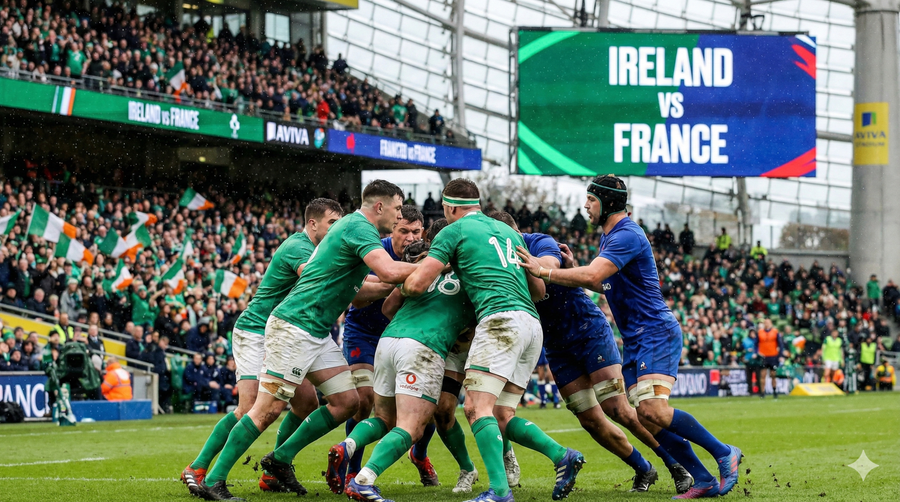
When we talk about the pinnacle of Northern Hemisphere rugby, one fixture stands above the rest: Ireland vs France. This isn’t just a game; it is a clash of cultures, styles, and sheer willpower. For fans in the USA looking to understand why this rivalry stops the world, imagine the intensity of a Super Bowl mixed with a centuries-old history. Every time these two nations step onto the grass, whether it’s at the Aviva Stadium in Dublin or the Stade de France in Paris, magic happens.
Over the last few years, this specific matchup has decided the winner of the Six Nations Championship more often than any other. Ireland brings a level of clinical precision and tactical discipline that is hard to match. On the other side, France offers “Rugby Champagne”—a style of play filled with flair, unexpected offloads, and breathtaking speed. When these two forces collide, the atmosphere is electric, and the stakes are always at an all-time high.
For American fans tuning in on Peacock or following the scores online, understanding the depth of this rivalry is key. It’s not just about the 80 minutes on the clock. It’s about the legendary players like Brian O’Driscoll and Antoine Dupont who have defined eras. It’s about the sea of green vs. the wave of blue. In this guide, we will dive deep into every aspect of this incredible sporting spectacle to see what makes it so special.
A Century of History: How the Rivalry Began
The story of Ireland vs France began way back in 1909. Can you imagine rugby back then? No high-tech jerseys or video reviews—just raw grit and leather balls. The first match took place in Dublin, and Ireland walked away with a 19-8 victory. Back then, France was the newcomer to the “Home Nations” tournament, and they struggled to find their feet against the established Irish side. However, the French didn’t stay down for long.
As the decades rolled on, the rivalry grew in complexity. France started to develop a style that was uniquely theirs. By the 1950s and 60s, they became a powerhouse, often using their physical size and creative backline play to overwhelm the Irish defense. There were long periods where Ireland found it nearly impossible to win in Paris. The “Parisians’ Fortress” was a real thing, and many Irish legends went their whole careers without a win on French soil.
Everything changed as we entered the professional era in the 1990s. The gap between the two teams narrowed, and the games became much more tactical. We started seeing high-scoring thrillers and defensive masterclasses. The history of this fixture is a mirror reflecting the evolution of rugby union itself. From the mud-soaked pitches of the early 20th century to the pristine hybrid grass of today, the passion has remained exactly the same.
Detailed Match Statistics: Ireland vs France Head-to-Head
To truly understand the dominance of these two teams, we have to look at the numbers. Statistics tell a story of shifts in power and home-ground advantage. While France has more total wins historically, Ireland has been the dominant force in the last decade. Below is a comprehensive table detailing the historical and recent stats for Ireland vs France as of early 2026.
Ireland vs France: Historical Breakdown
| Metric | France | Ireland |
| Total Matches Played | 105 | 105 |
| Total Wins | 61 | 37 |
| Draws | 7 | 7 |
| Highest Score | 45 (1996) | 38 (2024) |
| Largest Winning Margin | 39 points (2002) | 21 points (2024) |
| Most Recent Result (Feb 2026) | Won 36-14 | Lost 14-36 |
| World Ranking (Current Avg) | Top 3 | Top 3 |
These numbers highlight how difficult it is for the visiting team to secure a win. In recent years, the home team has won the vast majority of encounters. However, Ireland broke that trend with a massive statement win in Marseille in 2024. That game proved that this modern Irish squad is capable of winning anywhere in the world. Conversely, France’s win in Dublin in 2025 showed that “Les Bleus” can never be counted out, even when the crowd is against them.
The Tactical Chess Match: Coaching and Strategy
Modern rugby is as much about the “brains” as it is about the “brawn.” The battle between Andy Farrell (Ireland) and Fabien Galthié (France) is legendary. Andy Farrell has built an Irish system based on “relentless continuity.” His players move like a well-oiled machine, keeping the ball for long periods and tiring out the opposition. They rely on incredibly fast ruck speeds and a “next man up” mentality where every player knows their role perfectly.
On the other side of the pitch, Fabien Galthié has revitalized French rugby by embracing “Calculated Chaos.” While France is still known for their flair, Galthié added a world-class defensive system designed by Shaun Edwards. They focus on a heavy kicking game to gain territory and then use their massive forwards to dominate the breakdown. When they get a turnover, they strike like lightning. This contrast in styles makes Ireland vs France a fascinating watch for any sports analyst.
One of the most interesting parts of this tactical battle is how both teams handle pressure. Ireland thrives on structure, while France thrives on the unstructured. If Ireland can keep the game “tidy” and follow their plan, they usually win. If the game becomes “broken” and chaotic, the French athletes usually take over. It’s a constant tug-of-war for control that keeps fans on the edge of their seats for the full 80 minutes.
Iconic Venues: Aviva Stadium vs Stade de France
Where the match is played matters just as much as who is playing. The Aviva Stadium in Dublin is a cauldron of noise. Known for the “Lansdowne Roar,” the Irish fans create an atmosphere that is supportive and intimidating all at once. The stadium is located right in the heart of Dublin, and the energy from the city flows directly into the stands. For a French player, hearing “The Fields of Athenry” sung by 50,000 people is a true test of nerves.
Contrast that with the Stade de France in Saint-Denis, just outside Paris. This is a massive arena that holds over 80,000 people. When the French fans start singing “La Marseillaise,” the ground literally shakes. It is a more grandiose, operatic experience compared to the raw emotion of Dublin. The French crowd is also famously “knowledgeable” but “demanding.” If the home team isn’t performing, the whistles can be just as loud as the cheers.
For USA viewers, the difference in stadium culture is one of the coolest parts of the Six Nations. You aren’t just watching a game; you’re seeing a piece of national identity. In Dublin, it’s about community and resilience. In Paris, it’s about pride and artistic expression. Both venues provide a world-class stage for Ireland vs France, ensuring that every tackle and every try feels like it’s happening in a movie.
Legend of the Game: Brian O’Driscoll’s Impact
You cannot talk about Ireland vs France without mentioning the man who changed everything: Brian O’Driscoll. In the year 2000, Ireland hadn’t won in Paris for 28 years. They were the underdogs, and most people expected a routine French victory. Then, a young center with blonde hair and incredible speed took the field. O’Driscoll scored a hat-trick of tries that day, leading Ireland to a historic win and announcing himself as a world superstar.
That single match shifted the psychology of Irish rugby. Before that day, Irish teams often felt they weren’t “allowed” to beat the big teams away from home. O’Driscoll proved that with enough talent and belief, anything was possible. For the next 15 years, he was the primary threat that every French coach feared. His ability to find gaps in the defense and his legendary defensive “poaches” made him a nightmare to play against.
Even today, fans talk about “The BOD Era.” His legacy lives on in the current crop of Irish players like Garry Ringrose and Robbie Henshaw. They grew up watching O’Driscoll take down the giants in blue. Whenever Ireland vs France comes around, the highlights of that 2000 hat-trick are played on a loop. It serves as a reminder that one person can change the course of history in this great rivalry.
The Modern Maestro: Antoine Dupont and the French Revival
If O’Driscoll was the king of the early 2000s, Antoine Dupont is the king of today. Many experts call him the greatest player to ever pick up a rugby ball. As a scrum-half, he is the heartbeat of the French team. He is strong enough to tackle huge forwards, fast enough to outrun wingers, and smart enough to outthink everyone else on the pitch. When Ireland vs France kicks off, all eyes are on number 9.
Dupont has been the central figure in France’s return to the top of the world rankings. Before he arrived, France was going through a “dark age” where they were talented but inconsistent. Dupont brought a winning mentality. He doesn’t just play rugby; he controls it. Whether it’s a perfectly timed box kick or a miraculous solo try, he always seems to be in the right place at the right time.
For Ireland, stopping Dupont is “Job Number One.” In their recent encounters, the Irish defense has tried everything to slow him down. Sometimes it works, but more often than not, he finds a way to break through. The battle between the Irish defensive line and Dupont’s creative genius is the highlight of the modern era. He is the ultimate “X-factor” that makes the French side so terrifying to face.
Why This Match Matters for USA Rugby Fans
You might wonder why someone in New York or Los Angeles should care about Ireland vs France. The answer is simple: it is the highest level of athletic competition on the planet outside of the World Cup. As rugby continues to grow in the United States, this fixture serves as the perfect “entry point” for new fans. It has everything you want in a sport: high-speed action, physical contact, and deep emotional stakes.
Furthermore, with the Rugby World Cup coming to the USA in 2031, following these teams now lets you get ahead of the curve. Ireland and France will likely be among the favorites to win that tournament. By watching their Six Nations battles today, you are seeing the future stars of the American World Cup in their prime. It’s like watching the NBA Finals or the World Series—you are seeing the absolute best in the business do what they do.
The broadcast quality has also made it easier than ever to watch. With professional commentary that explains the rules (which can be a bit confusing at first!), USA viewers can quickly pick up the nuances of the game. Whether you are rooting for the Irish underdogs or the French artists, you are guaranteed a spectacle. Ireland vs France is the gold standard of international sport, and it’s finally getting the recognition it deserves across the Atlantic.
Key Players to Watch in 2026
As we look at the current squads, several names stand out as game-changers. For Ireland, Caelan Doris has emerged as a world-class captain and number eight. He is the engine room of the team, constantly carrying the ball into heavy traffic and winning turnovers. His leadership has been vital since the retirement of Johnny Sexton. If Doris is playing well, Ireland is almost impossible to stop.
On the French side, keep an eye on Louis Bielle-Biarrey. This young winger is essentially a human lightning bolt. He has the kind of speed that makes defenders look like they are standing still. In the 2025 and 2026 matches, he has been a nightmare for the Irish backline. Alongside him is the powerhouse Gregory Alldritt, a man who seemingly never gets tired. He does the “dirty work” in the scrums and rucks, allowing the stars like Dupont to shine.
We also have to mention the “Battle of the Fly-Halves.” With legends like Sexton and Ntamack moving on or dealing with injuries, new stars like Sam Prendergast for Ireland and Matthieu Jalibert for France have stepped up. These are the playmakers who decide where the ball goes and how the game is managed. Their tactical kicking and decision-making under pressure will ultimately decide who wins the next chapter of Ireland vs France.
The Fan Experience: Guinness, Champagne, and Songs
One of the best parts of the Ireland vs France rivalry happens off the pitch. Rugby is famous for its “Third Half”—the time after the game where fans from both teams drink and celebrate together. In Dublin, this means thousands of people crowding into Temple Bar to share a pint of Guinness. Even if your team lost, the respect between the two sets of fans is unmatched in almost any other sport.
In France, the experience is a bit more culinary. Fans might enjoy a glass of wine or champagne and some incredible local food before heading to the stadium. However, don’t let the “fancy” food fool you—French rugby fans are some of the loudest and most passionate in the world. They bring trumpets, drums, and endless energy to the stands. The “Allez Les Bleus” chant is something that stays with you long after the game ends.
This mutual respect is what makes the Six Nations special. There is no segregation of fans; everyone sits together. You’ll see a jersey of green right next to a jersey of blue, with both fans laughing and debating the latest referee decision. It is a beautiful example of how sports can bring different cultures together. If you ever get the chance to attend an Ireland vs France match in person, take it. It is a “bucket list” experience for any sports lover.
Frequent Asked Questions (FAQs)
1. Who has won more matches between Ireland and France?
Historically, France has the upper hand. In over 100 meetings, France has won 61 times, while Ireland has won 37, with 7 draws. However, in the modern era (since 2010), the results have been much more even.
2. Where can I watch Ireland vs France in the USA?
The best way to watch the Six Nations and most major rugby tests in the USA is through the Peacock streaming service. They provide live coverage and full-match replays of every game.
3. Why is this rivalry so important in the Six Nations?
Because Ireland and France have consistently been the two best-ranked teams in the Northern Hemisphere recently. Their match often acts as a “Grand Slam Decider,” meaning the winner usually goes on to win the whole tournament.
4. What is “Rugby Champagne”?
This is a term used to describe the traditional French style of play. It refers to a game that is bubbly, elegant, and exciting, characterized by creative passing, unpredictable moves, and beautiful tries.
5. Who is the top scorer in the history of this fixture?
For Ireland, legends like Ronan O’Gara and Johnny Sexton hold the records for most points. For France, players like Morgan Parra and Thomas Ramos have been clinical with their kicking boots over the years.
6. Is it harder to win in Dublin or Paris?
Both are incredibly tough. However, historically, Ireland struggled more in Paris. In the last few years, the “home field advantage” has been very strong for both sides, making “away” wins rare and very prestigious.
Conclusion: A Rivalry That Never Fails to Deliver
As we have seen, the Ireland vs France matchup is much more than just a game of rugby. It is a storied rivalry that has evolved over 120 years into the most exciting fixture in the sport today. Whether it’s the historical dominance of the French or the tactical brilliance of the modern Irish side, there is always something new to discover. The players may change, and the stadiums may get bigger, but the intensity remains the same.
For fans, this game represents the very best of what sports can be. It offers drama, heartbreak, and moments of pure joy. It brings together two proud nations in a display of mutual respect and fierce competition. As we look forward to the next time these two giants meet, one thing is certain: the world will be watching, and the rugby will be world-class.
About the Author